+375 17 317 14 14 (sales dept.)


Tilmicoforce-O


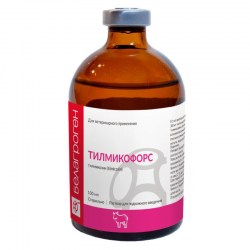
Veterinary drug TILMICOFORCE-O
For the treatment of infectious diseases in calves, pigs and poultry
- Broad spectrum of antibacterial activities
- For oral use
- Penetrates into most organs and tissues
- Maximum concentration of antibiotic is reached in 1.5-3 hours after the drug administration
- The therapeutic concentration is maintained for 24 hours
- Allowed for use in lactating and pregnant animals
Therapeutic indications:
The drug is prescribed to calves, pigs, and poultry (broilers, breeding poultry, parent flock poultry, replacement pullets) for respiratory diseases (mycoplasmosis, pasteurellosis, ornithobacteriosis, bordetellosis, streptococcosis), dysentery, and other diseases caused by microorganisms sensitive to tilmicosin.
Pharmacotherapeutic group:
Macrolides and azalides.
Dosage form description
Oral solution. In appearance, the drug is a transparent solution ranging from light yellow to brown in color.
1-liter polymer bottles and 5-liter canisters.
Composition of the veterinary drug:
1 ml of the drug contains 250 mg of tilmicosin (as tilmicosin phosphate) as the active substance.
Pharmacological activity:
Tilmicosin, the active substance of the drug, is primarily active against gram-positive and certain gram-negative microorganisms (Actinobacillus pleuropneumoniae, Mannheimia haemolytica, Pasteurella multocida, Staphylococcus spp., Streptococcus spp., Ornithobacterium rhinotracheale, Clostridium spp., Corynebacterium spp., Brachyspira spp., Bordetella spp., Spirochaeta spp., etc.), as well as Mycoplasma spp. and Chlamydia spp.
The mechanism of the bacteriostatic action of tilmicosin consists in the suppression of protein synthesis in the bacterial cell at the ribosomal level. Following oral administration, tilmicosin is well and rapidly absorbed from the gastrointestinal tract and penetrates into most organs and tissues of the body, reaching maximum serum levels within 1.5–3 hours. Therapeutic concentrations of the antibiotic are maintained in the body for 24 hours. Tilmicosin is excreted from the body primarily unchanged, mainly via feces and partially via urine.
Dosage:
The drug is administered to animals and poultry orally, individually or in group regimens in the following doses:
- poultry: in a group regimen with drinking water at a daily dose of 300 ml of the drug per 1000 liters of water (corresponding to 75 mg of tilmicosin per 1 liter) for 3 days;
- pigs: in a group regimen with drinking water at a daily dose of 15–20 mg of tilmicosin per 1 kg of animal body weight (corresponding to 800 ml of the drug per 1000 liters of water) for 5 days;
- calves: individually with drinking water, milk, or milk replacer twice a day at 0.5 ml of the drug per 10 kg of animal body weight (12.5 mg of tilmicosin per 1 kg of animal body weight) for 3–5 days.
An aqueous solution of the drug is prepared daily in a volume calculated for consumption during the day. Solutions of the drug based on milk and milk replacer are stable for 6 hours.
The daily dose of the drug may be administered by pulse dosing over 4–6 hours.
During the treatment period, animals and poultry must receive only the solution containing the drug, which is optional when applying the pulse dosing procedure.
Contraindications:
The drug is contraindicated in animals and poultry with increased individual sensitivity to the components of the drug, as well as with severe renal and hepatic insufficiency. It is not recommended to use the drug in ruminants with developed rumen digestion.
Overdose:
In case of an overdose of the drug in animals and poultry, a decrease in appetite, reduced water consumption, and weight loss may be observed. In this case, the drug is discontinued and general measures aimed at eliminating the medicinal drug from the body are applied.
Pregnancy and lactation:
The drug can be used in animals during pregnancy and lactation.
Special indications:
No specific effects of the drug's action upon its first use or discontinuation have been identified. It is necessary to avoid skipping a scheduled administration of the drug to animals and poultry, as this may lead to a decrease in therapeutic efficacy. If a dose is missed, the course of administration must be resumed in accordance with the prescribed dose and treatment regimen. A missed administration should not be compensated for by increasing the dose.
Side effects and individual intolerance:
Adverse reactions and complications when using the drug in accordance with this instruction are generally not observed. In animals and poultry with increased individual sensitivity to the components of the drug, allergic reactions may manifest. In this case, use of the drug is discontinued, antihistamines are prescribed if necessary, and symptomatic treatment is performed.
Interaction with other veterinary medicinal drugs:
The drug should not be used simultaneously and within 7 days before and after the use of ionophore anticoccidials, aminoglycoside antibiotics, due to the possible occurrence of adverse events and complications (allergy, dysbiosis, anorexia). To prevent a decrease in antibacterial activity, the drug should not be used simultaneously with drugs and feed additives containing bentonite.
Withdrawal period:
The use of the drug is prohibited for poultry (during the egg-laying period) whose eggs are intended for human food, as well as for replacement pullets less than 2 weeks before the start of egg laying. Slaughter of pigs and poultry for meat is permitted no earlier than 16 days, and calves no earlier than 42 days after administration of the drug. In the event of forced slaughter of animals and poultry earlier than the specified period, the meat may be used as feed for carnivorous animals.
Shelf-life:
2 years from the manufacturing date. Use of the drug after the expiration date is prohibited.
Storage conditions:
In a place protected from light at a temperature from 2 °C to 25 °C. The drug should be stored in a place inaccessible to children. After first opening of the bottle/canister – 28 days subject to storage conditions. The prepared aqueous solution of the drug is valid for 24 hours. The prepared solution based on milk and milk replacer is valid for 6 hours.
 Tilmikofors
 Respiroflor-O 100
 Enmitril-O
