+375 17 317 14 14 (sales dept.)


Tetrafors LA
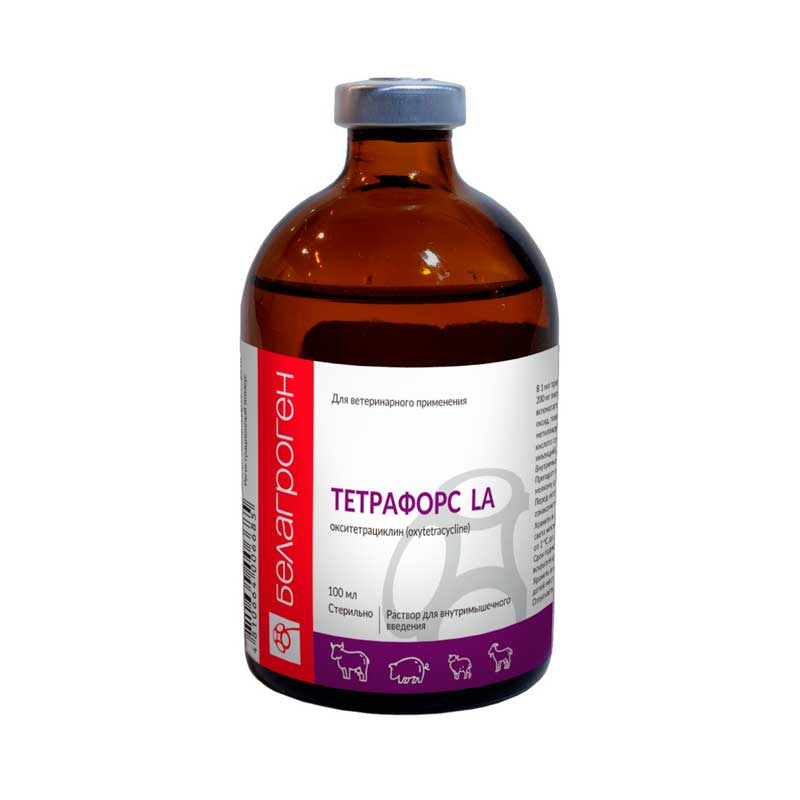

Veterinary drug TETRAFORS LA
Long-acting broad-spectrum antibacterial drug
- Antibacterial action against both Gram-negative and Gram-positive microorganisms
- Long-lasting effect due to magnesium-oxytetracycline combination
- Therapeutic concentrations of active substances are maintained for 2.5 - 3 days
- Approved for use in young animals
- Can be administered as a single or double dose
- Highly effective in the treatment of mastitis, hoof lesions (foot rot), keratoconjunctivitis, mastitis-metritis-agalactia syndrome, respiratory infections, and other infectious diseases
Therapeutic indications:
The drug is used in large and small ruminants, and pigs for the treatment of infectious diseases caused by oxytetracycline-sensitive pathogens, including respiratory diseases of bacterial etiology, pasteurellosis, atrophic rhinitis, enzootic abortion, mastitis, mastitis-metritis-agalactia syndrome, keratoconjunctivitis, hoof lesions (footrot), suppurative arthritis, umbilical sepsis, abscess, peritonitis, wound and postpartum infections, anaplasmosis, as well as for the treatment infections concominant to bacterial diseases.
Composition of the veterinary drug:
1 ml of the drug contains:
- 200 mg of oxytetracycline (in the form of oxytetracycline hydrochloride) as an active substance.
Pharmacological activity:
TETRAFORS LA is an antibacterial drug.
Oxytetracycline, the active substance of the drug, has a broad spectrum of antibacterial action. It is effective against most gram-negative and gram-positive bacteria, including: Escherichia coli, Salmonella spp., Proteus spp., Campylobacter spp., Pseudomonas aeruginosa, Bordetella spp., Pasteurella spp., Haemophilus spp., Actinobacillus spp., Brucella spp., Staphylococcus spp., Streptococcus spp., Listeria monocytogenes, Corynebacterium spp., Erysipelothrix rhusiopathiae, Fusobacterium necrophorum, Clostridium spp., as well as Mycoplasma spp., Chlamydia spp., Rickettsia spp., Treponema spp.
The mechanism of action of oxytetracycline is the inhibition of microbial protein synthesis. Oxytetracycline binds to the 30S ribosomal subunit in the bacterial cell. This prevents the incorporation of new amino acids into the growing peptide chain and leads to the death of microorganisms.
The prolonged action of the drug is due to the complex of oxytetracycline with magnesium. Following intramuscular administration, oxytetracycline is rapidly absorbed from the injection site and reaches maximum concentrations in organs and tissues within 30–50 minutes after administration. The therapeutic level of the antibiotic in blood serum is maintained for 60–72 hours. Oxytetracycline is eliminated from the body primarily via urine and bile; in lactating animals, partially via milk.
Dosage:
The drug is administered to animals once intramuscularly at a dose of 1 ml of the drug per 10 kg of body weight (equivalent to 20 mg of oxytetracycline per 1 kg of body weight). If necessary, the injection is repeated after 72 hours.
The maximum dose per injection site for cattle is 20 ml, for small ruminants and pigs – 5–10 ml. If the volume of the drug to be administered at a single site exceeds the specified amount, it should be given to the animal at multiple sites.
Contraindications:
Side effects and individual intolerance:
At the injection site, local reactions such as erythema, itching, and swelling may occur, which disappear spontaneously within a few days and do not require treatment. In animals with increased individual sensitivity to the components of the drug, allergic reactions may occur. In this case, use of the drug is discontinued, and if necessary, antihistamines are administered and symptomatic treatment is provided.
Interaction with other veterinary drugs:
Concurrent use of the drug with corticosteroids and estrogens is contraindicated. It is not recommended to use simultaneously with antibiotics of the penicillin and cephalosporin groups due to a marked reduction in the antibacterial effect of oxytetracycline. Mixing in the same syringe with other medicinal products is prohibited.
Withdrawal period:
Animals must not be slaughtered for human consumption before 30 days after the drug administration. Meat of animals forcibly slaughtered before the specified period expires may be used for feeding carnivores.
Milk of lactating animals must not be used for human consumption within 30 days after the drug administration. Milk obtained from lactating animals during the treatment period is allowed for animal feeding after thermal treatment.
Storage conditions:
Store in a dark place at a temperature between 2 ° C to 25 ° C.
The drug should be kept out of reach of children.
Shelf-life:
Shelf-life of the veterinary drug is 3 years from the date of manufacture. Shelf-life after first opening of the bottle is 28 days under appropriate storage conditions.
 Duocillin LA
 Streppen LA
 Extraclox