
Do not use the drug concurrently with antibiotics from the tetracycline, macrolide, lincosamide, and sulfonamide groups.
+375 17 317 14 14 (sales dept.)

Coliamox
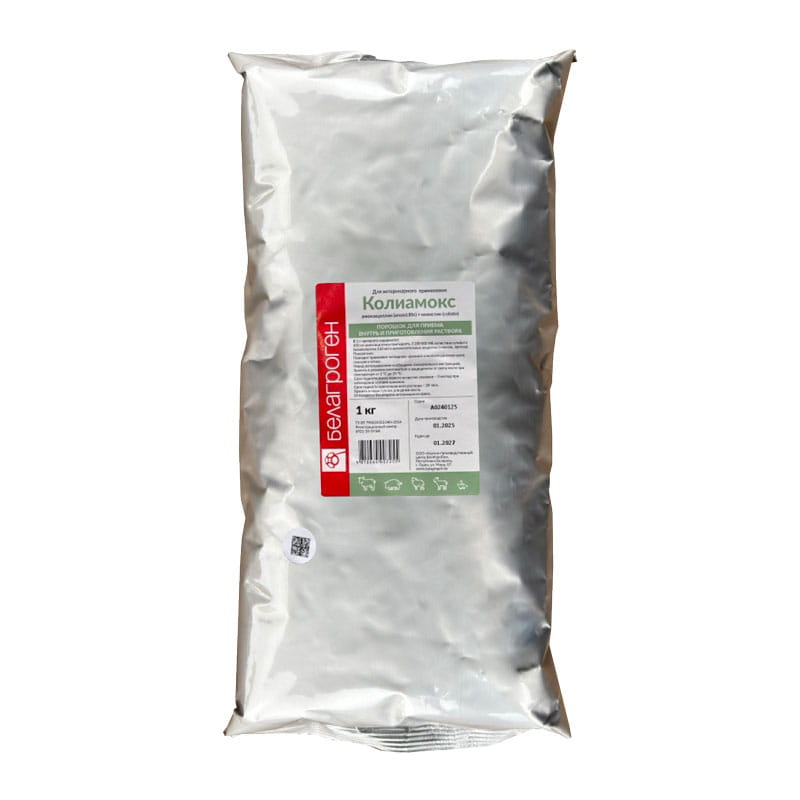

Veterinary drug COLIAMOX
Treatment of bacterial infections in young cattle, pigs and poultry
- Combined drug
- Contains a natural peptide antibiotic
- Broad spectrum of action against various microorganisms
- Highly effective and highly economical veterinary drug
- Administered orally
- Easy to use
Therapeutic indications:
The drug is used for the treatment of young cattle, sheep, goats, pigs, and poultry in cases of escherichiosis (colibacillosis), salmonellosis, staphylococcosis, streptococcosis, pseudomonosis, and other diseases caused by microorganisms sensitive to amoxicillin and colistin.
Composition of the veterinary drug:
The 1 g of the drug contains:
- 450 mg of amoxicillin trihydrate
- 3 200 000 МЕ (equivalent to 133 mg) colistin sulfate as active substances.
Pharmacological activity:
Coliamox is a complex antibacterial drug.
Amoxicillin is an antibiotic from the group of semisynthetic penicillins and possesses a broad spectrum of antimicrobial action against Staphylococcus spp., Erysipelothrix rhusiopathiae, Corynebacterium spp., Clostridium spp., Campylobacter spp., Brucella spp., Salmonella spp., Escherichia coli, Haemophilus spp., Bacteroides spp., Fusobacterium necrophorum, and Proteus spp.
Colistin sulfate is a mixture of sulfate polypeptides produced by certain strains of Bacillus polymyxa. Colistin has a pronounced bactericidal effect against most aerobic gram-negative microorganisms, including Escherichia coli, Klebsiella spp., Salmonella spp., Pasteurella spp., Bordetella spp., Enterobacter spp., Proteus spp., Pseudomonas aeruginosa, and some others.
The mechanism of action of amoxicillin involves disrupting bacterial cell wall synthesis by inhibiting the enzymes transpeptidase and carboxypeptidase, which leads to disruption of osmotic balance and destruction of the bacteria. Colistin disrupts the permeability of the cytoplasmic membrane by blocking its phospholipid components, resulting in the release of water-soluble cytoplasmic compounds into the surrounding environment.
Amoxicillin is well absorbed from the digestive tract and penetrates into all organs and tissues of animals and poultry. The maximum concentration in the blood is reached 1–2 hours after administration of the drug. Amoxicillin is eliminated from the body within 8–12 hours, primarily unchanged in the urine. After oral administration of the drug, colistin is not absorbed from the gastrointestinal tract and is not affected by digestive enzymes, resulting in a high concentration of the antibiotic in the intestine; it does not accumulate in organs and tissues and is eliminated from the body mainly unchanged in the feces.
Dosage:
The drug is administered individually or by group method in the following doses:
- for calves, lambs, and goat kids – 0.2 g of the drug per 10 kg of body weight of the animal twice daily for 3–5 days with feed or drinking water;
- for pigs – 1 kg of the drug per 2500–2850 L of drinking water, which corresponds to 0.2 g of the drug per 10 kg of body weight of the animal, twice daily for 3–5 days with feed or drinking water;
- for poultry – 1 kg of the drug per 2500–2850 L of drinking water, which corresponds to 0.07 g of the drug per 1 kg of body weight of the bird (when given individually), for 3–5 days. For poultry, the drug solution is prepared based on the birds’ daily water requirement. During the treatment period, poultry must receive only water containing the drug.
Precautions and adverse reactions:
In animals and poultry, the use of the drug may cause allergic reactions such as skin rash, erythema, and itching; in piglets, rectal prolapse; with prolonged use of the drug, dysbacteriosis; in rare cases, neurotoxic effects. In such cases, the use of the drug is discontinued, and if necessary, antihistamines and calcium preparations are prescribed.
It is not recommended to use the drug in animals and poultry with increased individual sensitivity to penicillins, cephalosporins, polypeptides, as well as in cases of impaired renal excretory function and in ruminants with developed rumen digestion.
No overdose symptoms when using the drug have been observed.
After the first administration and cancellation no peculiarities are revealed.
Avoid skipping the next dose of the drug, as this may lead to a decrease in therapeutic efficacy. If administration of the veterinary drug is missed, resume it in the same dosage according to the same treatment scheme.
Withdrawal period:
Do not use in poultry, whose egg is used for human food, as well as in repair young chickens less than 2 weeks before the start of egg laying.
Animals and poultry should not be slaughtered for human consumption within 14 days after the last treatment. Meat of animals forcibly slaughtered earlier than the specified period expires may be used for feeding carnivores.
Storage conditions:
Store in a dark place at a temperature between 2 °C to 25 °C.
Shelf-life:
Shelf-life of the veterinary drug under appropriate storage conditions is 2 years from the date of manufacture, after the first opening of the package - 3 month. The shelf-life of working solution is 24 hours, respectivly. Do not use after expiry date.
 Colistin-O
 Amoxicillin-800
 Colidox
 Colistin-O