+375 17 317 14 14 (sales dept.)


Salicylate-P


Veterinary drug SALICYLATE-P
Anti-inflammatory and analgesic agent for cattle, small ruminants, pigs and poultry
- Anti-inflammatory, antipyretic and analgesic action
- Prevents thrombosis
- Easy to administer (with water or feed, individually or in groups)
- Rapidly absorbed and penetrates most organs and tissues
- Withdrawal period for meat: 1 day
- Effective in the treatment of mastitis-metritis agalactia (MMA) syndrome
Therapeutic indications:
The drug is used in cattle and pigs for diseases accompanied by symptoms of inflammation and pain, including respiratory and gastrointestinal diseases, mastitis-metritis-agalactia syndrome in pigs, rheumatoid arthritis, osteoarthritis, muscle and postoperative pain, and heat stress in animals; poultry (broilers, breeding birds, parent stock, replacement pullets) during heat stress caused by high temperatures and in complex therapy for infectious diseases.
Pharmacotherapeutic group:
Non-steroidal anti-inflammatory drugs – salicylic acid derivatives.
Dosage form description
Powder for oral administration and for preparation of a solution for oral administration. In appearance, the drug is a powder from white to light yellow in color.
Bags made of metallized polymer film, 1 kg, and multi-layer paper bags with a polyethylene coating (liner), 25 kg.
Composition of the veterinary drug:
1 g of the drug contains 700 mg of acetylsalicylic acid as the active substance.
Pharmacological activity:
Acetylsalicylic acid, the active substance of the drug, is an ester of salicylic acid and possesses anti-inflammatory, antipyretic, and analgesic effects, and inhibits thrombus formation. Acetylsalicylic acid inhibits cyclooxygenase and irreversibly suppresses the cyclooxygenase pathway of arachidonic acid metabolism. It reduces hyperemia, exudation, capillary permeability, hyaluronidase activity, and limits the energy supply of the inflammatory process by suppressing ATP production. It affects the subcortical centers of thermoregulation and pain sensitivity. A decrease in prostaglandin levels in the thermoregulation center leads to a decrease in body temperature due to vasodilation of skin vessels and increased sweating. The analgesic effect is due to the effect on pain sensitivity centers, as well as the peripheral anti-inflammatory effect and the ability of salicylates to reduce the algogenic effect of bradykinin (a mediator of pain and inflammation). A decrease in thromboxane content in platelets leads to irreversible inhibition of aggregation and slightly dilates blood vessels. After oral administration of the drug, acetylsalicylic acid is rapidly absorbed from the gastrointestinal tract and penetrates into most organs and tissues of the body. It is metabolized in the liver with the formation of salicyluric acid, salicylglucuronide, and gentisic acid. In the blood, it is 70–90% bound to plasma proteins. Salicylates and their metabolites are excreted by the kidneys through filtration and tubular secretion.
Dosage:
The drug is administered with drinking water or mixed with feed for 3–5 days in the following daily doses (daily doses may be divided into two administrations):
- for cattle and small ruminants – 1 g of the drug per 7 kg of animal body weight;
- for pigs – 0.5–1.0 g of the drug per 7 kg of animal body weight;
- for poultry – 0.5–1.0 g of the drug per 7 kg of bird body weight, which corresponds to 300–600 g of the drug per 1000 L of drinking water.
When administered to groups, the drug is used for 3–5 days at a dose of 300–600 g of the drug per 1000 L of drinking water.
The dose of the drug can be increased up to 1200 g per 1000 L of drinking water under high temperature conditions in poultry houses, during heat stress, with high stocking density, and severe clinical conditions of poultry.
Prepare a stock solution by dissolving no more than 1 kg of the drug in 10 L of drinking water with periodic stirring. The optimal water temperature should be between 25–35 °C. Foaming may occur during dissolution. After ensuring the drug is completely dissolved, mix the resulting solution with the required amount of water. Pulse dosing is possible.
Contraindications:
Do not administer to animals and poultry with increased individual sensitivity to salicylates and other non-steroidal anti-inflammatory drugs. Do not administer to piglets younger than 30 days of age, old animals, as well as animals with gastrointestinal diseases, liver or kidney failure, impaired blood clotting, when using anticoagulants, and 2 weeks before scheduled surgery. Do not administer to animals and poultry with severe dehydration, hypovolemia, or hypotension requiring parenteral rehydration.
Overdose:
In case of drug overdose, animals and poultry may experience intoxication manifested by nausea, diarrhea, and hematological disorders (anemia, hematomas, nosebleeds). In this case, discontinue the drug and, if necessary, prescribe symptomatic treatment. In case of overdose, animals and poultry may experience intoxication, manifested by nausea, polypnea, respiratory and hematological disorders (anemia, hematomas, nosebleeds). In this case, the drug is discontinued and, if necessary, symptomatic treatment is prescribed.
Pregnancy and lactation:
Do not administer the drug to animals during pregnancy and lactation.
Special indications:
No specific effects have been observed upon first use or discontinuation of the drug. Avoid missing subsequent doses of the drug for animals and poultry, as this can lead to a decrease in therapeutic efficacy. If a dose is missed, resume the course of administration according to the prescribed dose and regimen. Do not compensate for a missed dose by increasing the dose.
Side effects and individual intolerance:
Side effects and complications are generally not observed when the drug is used according to these instructions. In animals and poultry with increased individual sensitivity to the drug components, allergic reactions may occur. In such cases, discontinue the use of the drug, and if necessary, prescribe antihistamines and symptomatic treatment.
Interaction with other veterinary medicinal products:
Do not administer the drug together with other non-steroidal anti-inflammatory drugs and corticosteroids. Do not administer together with aminoglycoside antibiotics and fluoroquinolones, as kidney toxicity increases. Acetylsalicylic acid enhances the effect of anticoagulants, analgesics, anesthetics, and tranquilizers.
Withdrawal period:
Slaughter of animals and poultry for meat is allowed no earlier than 1 day after drug administration. In case of forced slaughter of animals before the specified period, meat can be used for feeding carnivorous animals. Do not administer the drug to poultry whose eggs are intended for human consumption, as well as to replacement pullets less than 4 weeks before the start of laying. Do not administer the drug to productive animals whose milk is intended for human consumption.
Shelf-life:
2 years from the date of production. The use of the drug after its expiration date is prohibited.
Storage conditions:
In the manufacturer's packaging, protected from light at a temperature from 2 °C to 25 °C. The drug should be stored out of reach of children. After the first opening of the packaging – 3 months under storage conditions. The prepared solution of the drug is valid for 24 hours.
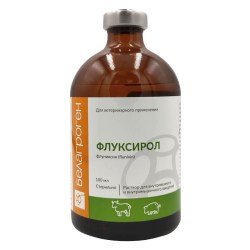 Fluxirol
 Megluflor
 Mastinet
