+375 17 317 14 14 (sales dept.)


Megluflor
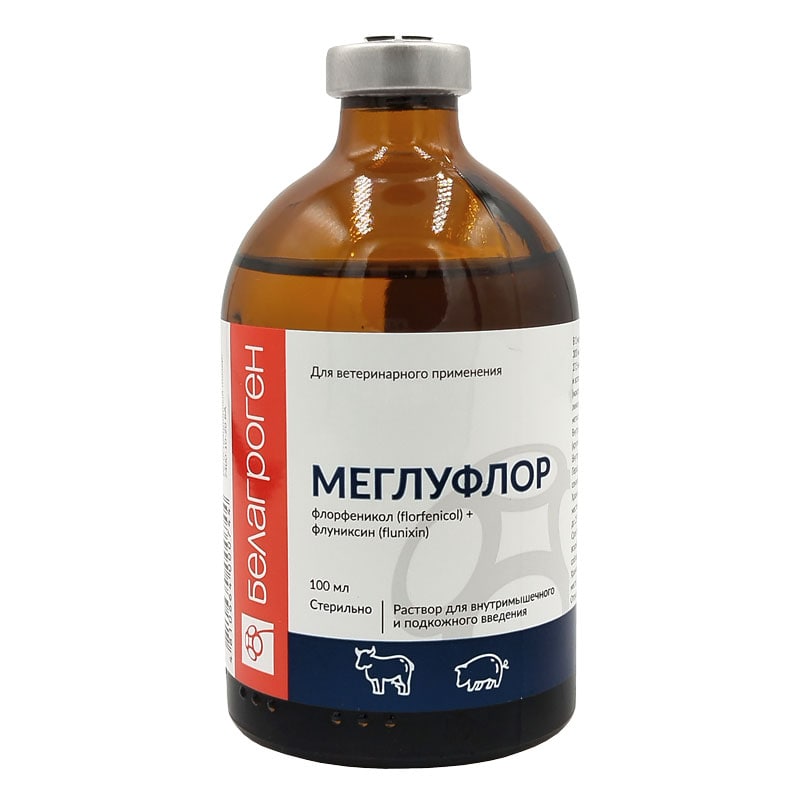

Veterinary drug MEGLUFLOR
Treatment of respiratory infections (SRD, BRD); bacterial pathologies of hooves, skin, mucous membranes of eyes
- Complex antibacterial, analgesic, antipyretic and anti-inflammatory action
- Effective against gram-positive and gram-negative pathogenic microorganisms
- Powerful antibacterial effect
- High bioavailability (penetrates the blood–brain barrier)
- Fast-acting drug
- Therapeutic concentration of active substances in the blood is maintained for 48 hours
Therapeutic indications:
The drug is used in pigs and cattle for the treatment of infectious diseases of bacterial etiology, the causative agents of which are sensitive to florfenicol; as well as for the treatment of secondary bacterial infections.
The drug is used in pigs for the treatment of respiratory infections (SRD), including pleuropneumonia (lung fever), caused by Actinobacillus pleuropneumoniae and\or Haemophilus parasuis, Pasteurella multocida, Mycoplasma hyopneumoniae, Mycoplasma hyorhinis; atrophic rhinitis.
The drug is used in cattle for the treatment of respiratory infections (BRD), caused by Pasteurella multocida, Klebsiella pneumoniae, Streptococcus pneumonia, Haemophilus somnus; as well as hoof lesions (footrot, acute interdigital necrobacillosis (interdigital phlegmon), infectious pododermatitis) and infectious bovine keratoconjunctivitis, caused by Moraxella bovis.
Composition of the veterinary drug:
1 ml of the preparation contains:
- 300 mg of florfenicol,
- 27,5 mg of flunixin meglumine as an active substances.
Pharmacological activity:
MEGLUFLOR is a complex antibacterial drug.
Florfenicol is the active substance of the drug. Florfenicol is a synthetic antibiotic of the fenicol group, a thiamphenicol derivative. In the florfenicol molecule, the hydroxyl group is replaced by a fluorine atom.
In the protoplasm of a bacterial cell, florfenicol binds to the 50S ribosomal subunit and suppresses the enzyme peptidyl transferase, that results in the inhibition of protein synthesis in bacteria at ribosomal level.
Florfenicol is active against bacteria producing acetyltransferase.
Florfenicol has a broad spectrum of bactericidal action against gram-positive and gram-negative pathogenic microorganisms, including Staphylococcus spp., Streptococcus spp., Enterobacter spp., Escherichia coli, Mannheimia haemolytica, Pasteurella multocida, Fusobacterium necrophorum, Bacteroides melaninogenicus, Actinobacillus pleuropneumoniae, Haemophilus spp., Bordetella bronchiseptica, Salmonella spp., Moraxella spp., Klebsiella spp., Proteus spp., etc.
Also florfenicol is active against some mycoplasma, including Mycoplasma hyopneumoniae, Mycoplasma hyorhinis, etc.
Florfenicol administered parenterally is actively absorbed from the injection site and penetrates into most organs and tissues of the animal body. The maximum concentration of the antibiotic is reached in the blood after 3.3 hours. A therapeutic concentration of the active substance in organs and tissues is maintained for 48 hours after the drug administration.
Florfenicol and its metabolites are mainly excreted from the animal's body in unchanged form mainly with urine and to a lesser extent with faeces.
Flunixin meglumine is another active substance of the drug. Flunixin meglumine is a non-steroidal anti-inflammatory compound with powerful analgesic and antipyretic effect. Flunixin meglumine is a non-selective inhibitor of cyclooxygenases (COX-1 and COX-2), which reduces the production of prostaglandins E2.
MEGLUFLOR has analgesic, antipyretic and anti-inflammatory effects due to the decrease in the production of inflammatory mediators.
Flunixin meglumine administered parenterally is quickly and fully absorbed from the gastrointestinal tract and penetrates into all animal organs and tissues. The maximum concentration of flunixin meglumine is reached in the blood after 1.3 hours. A therapeutic concentration of the active substance in organs and tissues is maintained for 48 hours after the drug administration.
Flunixin meglumine is 99% bound to proteins. Flunixin is mainly excreted from the animal's body in unchanged form mainly with faeces (57 %) and to a lesser extent with urine (34 %).
Dosage:
The drug is administered to cattle once subcutaneously in the neck area at a dose of 2 ml of the drug per 15 kg of animal body weight (which corresponds to 40 mg florfenicol and 2.2 mg flunixin per 1 kg of animal body weight). Double intramuscular administration of the drug at interval of 48 hours at a dose of 1 ml of the drug per 15 kg of animal body weight (which corresponds to 20 mg florfenicol and 1.1 mg flunixin per 1 kg of animal body weight) is possible.
In pigs the drug is administered intramuscularly in the neck area at a dose of 1 ml of the drug per 20 kg of animal body weight (which corresponds to 15 mg florfenicol and 0.825 mg flunixin per 1 kg of animal body weight) twice with an interval of 48 hours.
Due to the possible severe pain reaction, do not inject more than 10 ml per injection site. Make injections only in the neck. Do not reduce the dose of the drug, as it may lead to the impair therapeutic effect.
Precautions and adverse reactions:
Generally, no side effects and complications are observed when using the drug in accordance with the instruction. In some cases, a local inflammatory reaction may appear at the injection site, which spontaneously disappears without the use of therapeutic agents.
In case of allergic reactions, the drug should be canceled, antihistamines and calcium preparations should be prescribed; abundant drinking with 2% sodium bicarbonate solution.
Do not use in animals with hypersensitivity to the components of the drug. Do not use in animals with severe heart, liver and kidney dysfunction, severe dehydration or when the risk of gastrointestinal poisoning is high.
In case of an overdose of the drug in animals, depression, decreased appetite, decreased water intake and weight loss may be observed.
Do not use the drug simultaneously with thiamphenicol; antibiotics of the penicillin, cephalosporins, fluoroquinolones groups; non-steroidal anti-inflammatory drugs and corticosteroid drugs due to the increased risk of ulceration in the gastrointestinal tract of animals. Do not mix with other drugs in the same syringe.
Do not use the drug in springer cows, farrowing sows, calves that are 6 weeks of age or younger, breeding boars and stud bulls.
Withdrawal period:
Cattle and pigs must not be slaughtered for human consumption before 46 days after the last drug administration. Meat of animals forcibly slaughtered before the specified period expires may be used for feeding carnivores.
The drug is prohibited for use in productive animals, which milk is used for human consumption.
Storage conditions:
Store in a dark place at a temperature between 2 °C to 25 °C. The drug should be kept out of the reach of children.
Shelf-life:
Shelf-life of the veterinary drug under appropriate storage conditions is 3 years from the date of manufacture, after the first opening of the bottle (vial) - 28 days.
 Respiroflor 300
 Recefur PS-100
 Recefur PS-200