+375 17 317 14 14 (sales dept.)


Luteostenol
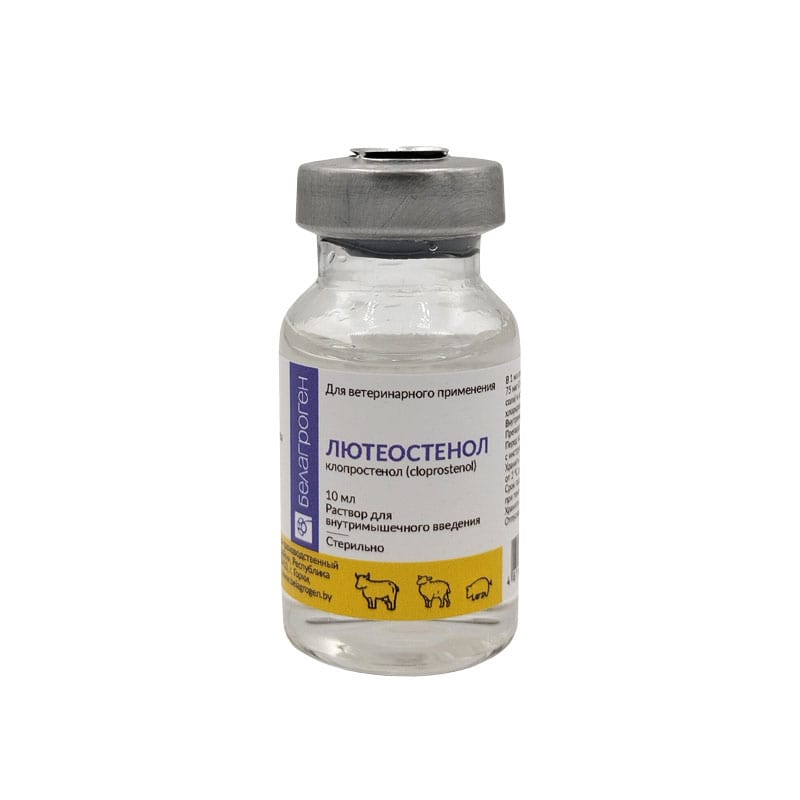
Veterinary drug LUTEOSTENOL
Regulation of the sexual cycle and treatment of gynecological diseases
- High biological activity of the active substance
- Fast-acting drug
- Estrous (heat) synchronization in cows and heifers
- Treatment of cystic ovarian disease in cows
- Treatment of the persistent corpus luteum in cattle
- Treatment of postpartum endometritis and uterine involution in cows
- Treatment and prevention of incomplete dilation of cervix in sheep
- Termination of pregnancy (abortion) in animals
- Restoration of reproductive function in sows
- Synchronization of farrowing and prevention of postpartum diseases in sows
- No withdrawal period for milk
Therapeutic indications:
The drug is administered to
- cows and heifers for the synchronization and induction of estrus, treatment of cows with lutein and follicular cysts, persistent corpus luteum, uterine subinvolution, and endometritis;
- pigs for the treatment and prevention of ovarian functional disorders, induction and synchronization of farrowing;
- sheep for cervical dilation; and for the termination of pregnancy in animals (according to indications).
Pharmacotherapeutic group:
Prostaglandins, thromboxanes, leukotrienes, and their antagonists.
Dosage form description
Solution for intramuscular administration. In appearance, the drug is a clear, colorless solution.
Transparent glass vials of 10 ml.
Composition of the veterinary drug:
1 ml of the drug contains 75 mcg of D-cloprostenol (in the form of D-cloprostenol sodium salt) as the active substance.
Pharmacological activity:
D-cloprostenol, the active substance of the drug, is the dextrorotatory optical isomer of cloprostenol, a synthetic analogue of prostaglandin F2α. D-cloprostenol is characterized by a biological activity 3.5 times greater than that of cloprostenol (the racemic mixture of DL-cloprostenol). D-cloprostenol exerts a luteolytic (dissolving) effect on the corpus luteum of the ovaries, removes the inhibitory effect of progesterone on the hypothalamic-pituitary complex, which promotes follicular growth in the ovaries, increases blood estrogen levels, and leads to estrus, heat, and subsequent ovulation of mature follicles.
The time from drug administration to the first signs of estrus is 48–60 hours. The drug enhances the contractile function of the uterus and exhibits biological activity only when actively functioning corpora lutea are present in the ovaries. In the animal body, D-cloprostenol is rapidly metabolized and excreted in the urine within 24 hours.
Dosage:
Before administering the drug, a gynecological examination of the animals is performed. The drug is administered intramuscularly in the following doses and regimens.
Cows and heifers.
Estrus synchronization: 2 ml of the drug (corresponding to 150 mcg of D-cloprostenol) is administered twice with an interval of 11 days between administrations. The first dose of the drug is administered in any phase of the estrous cycle (in cows, during the period from the 40th to the 60th day post-calving). Double artificial insemination is performed 72 and 96 hours after the second administration of the drug (regardless of external signs of estrus).
Induction of estrus (also for cows with unexpressed or hidden signs of estrus): 2 ml of the drug (corresponding to 150 mcg of D-cloprostenol) is administered after the detection of a corpus luteum (6th–18th day of the estrous cycle); estrus usually appears within 48–60 hours. Therefore, artificial insemination should be performed 72–96 hours after drug injection. If estrus has not started, the injection must be repeated 11 days after the first administration.
Induction of parturition: 2 ml of the drug (corresponding to 150 mcg of D-cloprostenol) is administered after 270 days of gestation. Calving should occur 30–60 hours after injection.
Treatment for follicular ovarian cysts: chorionic gonadotropin is administered subcutaneously once at a dose of 4000–5000 IU, or alarelin intramuscularly at 5 ml for 3 consecutive days. After 11 days, animals that have not come into estrus are administered the drug at a dose of 2 ml (corresponding to 150 mcg of D-cloprostenol).
Treatment for ovarian functional disorders (persistent corpus luteum, luteal cyst): the drug is administered at a dose of 2 ml (corresponding to 150 mcg of D-cloprostenol), and artificial insemination is performed at the first signs of estrus. If estrus does not occur, 2 ml of the drug (corresponding to 150 mcg of D-cloprostenol) should be re-administered 11 days after the first injection, followed by insemination 72–96 hours later according to the instructions.
Treatment of postpartum endometritis and pyometra: administer a 2 ml dose (equivalent to 150 µg of D-cloprostenol); if necessary, repeat the injection after 10–11 days.
Treatment of uterine subinvolution: administer a 2 ml dose (equivalent to 150 µg of D-cloprostenol); if necessary, repeat the injection after 24 hours.
Sows
Restoration of reproductive function: for sows that have not shown signs of estrus within 12 days after weaning, administer a 1 ml dose of the product (equivalent to 75 µg of D-cloprostenol) in combination with a gonadotropic agent.
Farrowing synchronization and prevention of postpartum disorders: administer a 1 ml dose of the product (equivalent to 75 µg of D-cloprostenol) on day 113 of gestation, followed by a second dose 6 hours later. Alternatively, a myometrial stimulant, such as oxytocin, may be administered 20 hours after the first injection. When following the two-injection protocol, 70–80% of the animals farrow within 20–30 hours of the first injection.
Sheep
Treatment and prevention of failure of the cervix to dilate: administer a 2 ml dose of the drug (equivalent to 150 µg of D-cloprostenol) to pregnant ewes 15–16 days before the expected lambing date. In cases of complete vaginal prolapse occurring 3–5 days before parturition, administer the drug at the aforementioned dose in combination with 2 ml of a 0.1% oily solution of estradiol dipropionate.
Termination of unwanted pregnancy (when indicated) is achieved by administering a 2 ml dose (equivalent to 150 µg of D-cloprostenol).
The injection site must be thoroughly cleaned and disinfected to eliminate the risk of infection by anaerobic bacteria (such as Clostridium species and others).
Contraindications:
The drug is contraindicated in animals with hypersensitivity to its components, as well as those with respiratory and cardiovascular diseases.
Overdose:
Symptoms of overdose upon administration of the drug are generally not observed. In case of overdose, symptomatic therapy is used. If allergic reactions occur, the drug is discontinued, and antihistamines and calcium preparations are prescribed.
Pregnancy and lactation:
The drug is contraindicated in pregnant animals, except in cases of forced termination of pregnancy or induction of parturition. Administration of the drug to sows before 113 days of gestation can negatively affect the viability and weight of newborn piglets. The drug is prescribed only when the exact date of insemination is known.
Special indications:
No specific features of the drug's action upon its first use or discontinuation have been identified. Skipping regular application should be avoided, as this may lead to a decrease in therapeutic efficacy. If an application is missed, the course must be resumed in accordance with the prescribed dose and treatment regimen. A missed administration should not be compensated by increasing the dose.
Side effects and individual intolerance:
Adverse reactions and complications when using the drug in accordance with these instructions are generally not observed.
Withdrawal period:
Slaughter of animals for meat is permitted no earlier than 24 hours after the last administration of the drug. In case of forced slaughter earlier than the specified period, the meat may be used to feed carnivorous animals. Milk obtained from animals treated with the drug may be used for food purposes without restriction.
Shelf-life:
2 years from the date of manufacture. Use of the drug after the expiration date is prohibited.
Storage conditions:
In a place protected from light at a temperature from 2 °C to 25 °C. The drug should be kept out of the reach of children. After initial opening of the vial, store for 28 days at a temperature from 2 °C to 8 °C.
 BAG-Estrofan
 BAG-Gonadorelin
 BAG-Surfagon
