+375 17 317 14 14 (sales dept.)


Sutrimet
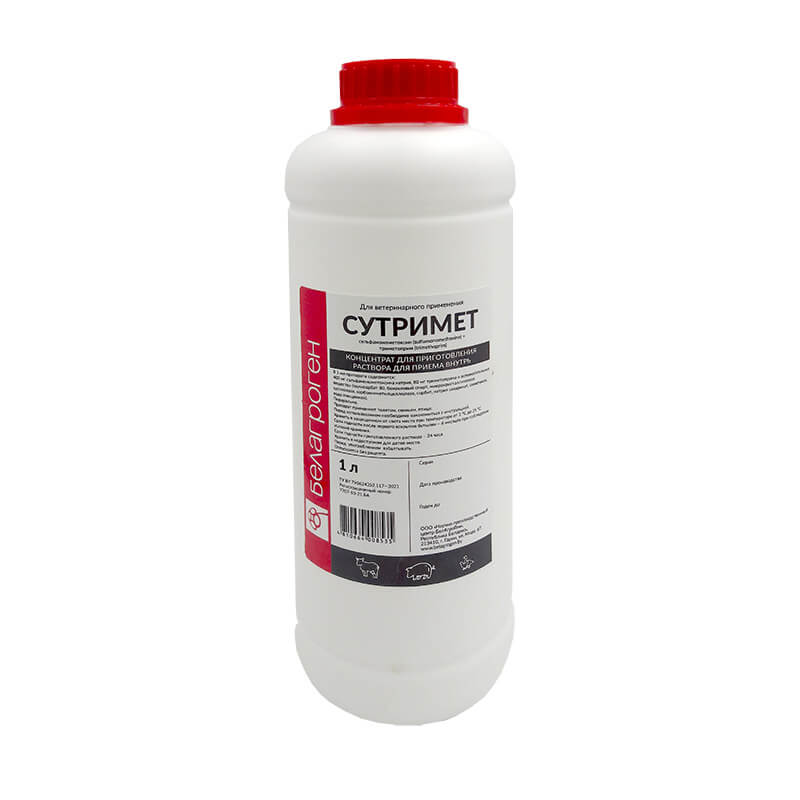

Veterinary drug SUTRIMET
For the treatment of infectious diseases in calves, pigs and poultry
- A broad-spectrum antibacterial combination drug
- Has both antibacterial and anti-eimerial effects
- Safe for pregnant and lactating animals
- For oral administration
- High bioavailability, remains active for 24 hours after ingestion
ORIGINAL UNIQUE WATER-BASED SUSPENSION - ANY DILUTION, NO CRYSTALLIZATION, NO SEDIMENT
Therapeutic indications:
The drug is used in calves with colisepticemia, salmonellosis, pasteurellosis, bronchopneumonia, abscesses caused by staphylococci, polyarthritis caused by streptococci; in pigs - with colibacillosis, atrophic rhinitis, salmonellosis, pasteurellosis, toxoplasmosis, hemophilic pleuropneumonia; in broiler chickens and replacement poultry - with colisepticemia, pasteurellosis, colibacillosis, salmonellosis, staphylococcosis, eimeriosis.
Composition of the veterinary drug:
1 ml of the drug contains as active ingredients:
- 400 mg sulfamonomethoxin sodium,
- 80 mg trimethoprim.
Pharmacological activity:
SUTRIMET is a combined antibacterial drug containing sulfamonomethoxin and trimethoprim as active ingredients. Their combination provides a broad spectrum of antimicrobial activity against gram-positive and gram-negative microorganisms, including Streptococcus spp., Staphylococcus spp., Escherichia coli, Shigella spp. and others, as well as some protozoa such as Eimeria spp., Toxoplasma gondii.
Sulfamonomethoxin is similar in structure to para-aminobenzoic acid, disrupts the synthesis of dihydrofolic acid in bacterial cells, preventing the inclusion of para-aminobenzoic acid in its molecule. Trimethoprim enhances the effect of sulfamonomethoxin, disrupting the reduction of dihydrofolic acid to tetrahydrofolic acid, the active form of folic acid, which is responsible for protein metabolism and microbial cell division. With the combined action, the synthesis of folic acid is disrupted at two successive stages, which leads to a deterioration of the nucleotides synthesis and causes a synergistic bactericidal effect.
The active ingredients of the drug are rapidly absorbed from the gastrointestinal tract and penetrate into all organs and tissues of the body, where they stay in a therapeutic concentration for 24 hours; excreted from the body mainly in the urine, to a lesser extent in the bile.
Dosage:
The drug is administered orally with drinking water, individually or in groups in the following doses::
- calves, pigs receives 1-2 ml of the drug per 32 kg of animal body weight for 5 days;
- poultry with eimeriosis receives 0.2-0.3 ml of the drug per 1 kg of body weight of the bird (corresponds to 100 ml of the drug per 100 liters of drinking water) for 3-5 days; for diseases of bacterial etiology - 1 ml of the drug per 32 kg of bird body weight for 5 days.
Animals and poultry subjected to herd treatment should receive only drinking water containing the drug.
With an individual method of administration, the daily dose of the drug should be divided into two equal parts and given to the animals in two doses, with an interval of 12 hours.
The solution with the drug is prepared daily during the treatment period.
Shake the drug before use.
Precautions and adverse reactions:
Adverse reactions are usually not observed. In animals with increased individual sensitivity to the components of the drug, allergic reactions are possible. In this case, the use of the drug is discontinued and antihistamines are prescribed.
Do not use in animals and poultry with impaired renal and liver function, laying hens, as well as with increased individual sensitivity to the components of the drug.
Overdose symptoms of in animals and poultry have not been revealed.
The use of the drug simultaneously with para-aminobenzoic acid derivatives, such as local anesthetics: procaine, tetracaine and procainamide, is contraindicated. Also, the drug should not be used with B vitamins (nicotinamide, folic acid, choline) due to their antagonistic effect on sulfonamides.
After the first administration and cancellation, no peculiarities of the drug use are revealed.
If administration of the veterinary drug is missed, resume it in the same dosage according to the same treatment scheme as soon as possible. Do not use a higher doses to offset a missed one.
No special aspects of the drug use during pregnancy and lactation have been identified. In these cases, the drug is used under the supervision of a veterinarian.
The preparation must not be used for poultry, whose egg is used for human consumption.
Withdrawal period:
Animals should not be slaughtered for human consumption within 10 days after the last treatment; poultry in the treatment of eimeriosis should not be slaughtered for human consumption before 10 days, and in the treatment of diseases of bacterial etiology - not earlier than 4 days after the last use of the drug. Meat of animals and poultry forcibly slaughtered earlier than the specified period expires may be used for feeding carnivores.
Storage conditions:
Store in a dark place at a temperature between +2°C to +25°C. The drug should be kept out of the reach of children.
Shelf-life:
Shelf-life of the veterinary drug is 3 years from the date of manufacture. Shelf-life after the first opening of the bottle is 6 month under appropriate storage conditions. The prepared working solution should be used within a day. Do not use the drug after the expiry date. Unused veterinary drug should be utilized in accordance with the requirements of the law. Available without prescription.
 Colistin-O
 Lazilide
 Sutrimet-forte
