+375 17 317 14 14 (sales dept.)


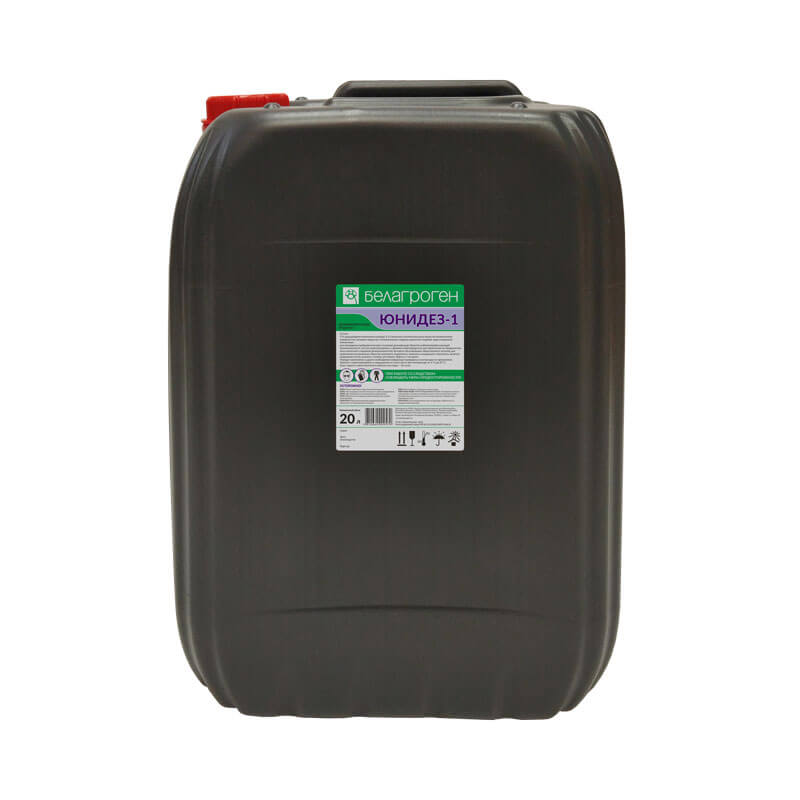
Unidez-1

Disinfectant UNIDEZ-1 with detergent and deodorizing effects
- Pronounced bactericidal, fungicidal, and virucidal action
- Suitable for disinfecting premises, objects, air, and transport
- Economical (0.25% - 2% working solution)
- Effective against viral diseases in poultry (avian influenza, chicken infectious anemia, infectious bursitis, avian reovirus)
- Effective against African swine fever (special certificate)
- Effective against necrobacteriosis, for disinfecting cattle hooves
- Does not cause corrosion or other changes to the structure of treated materials, low toxicity
- Suitable for disinfecting hatching eggs
The only disinfectant approved for vehicle disinfection at the state border
Application:
UNIDEZ-1 is used to prevent and control pathogen contamination in the objects of veterinary supervision: poultry and livestock barns and premises, sanitary equipment, workwear, vessels, containers, animal care items, transport, sanitary slaughterhouses, etc.
Composition:
100 ml of the disinfectant contains 5 g of quaternary ammonium compound and 6 g of glyoxal as active substances, as well as a non-ionic surfactant, ethyl cellosolve, fragrance, dye and water.
Properties:
Disinfectant UNIDEZ-1 has a bactericidal, fungicidal and virucidal effect. It is active against pathogens of the 1st, 2nd and 3rd groups of disinfectants resistance.
The mechanism of disinfection activity is based on the interaction of hydrophobic cations from UNIDEZ-1 with the bacterial cell membrane. As a result, the lipoid part of the cell membrane dissolves and the cell protoplasm mixes with the environment, causing cell death.
Disinfectant UNIDEZ-1 has detergent properties due to the presence of non-ionic surfactant. The surfactant molecule binds to dirt particles, and after the formation of hydrogen bonds, dissolves them in water. UNIDEZ-1 is not compatible with soaps and anionic surfactants.
Disinfectant UNIDEZ-1 is low-hazard solution. In working concentrations, it may have a weak skin-irritating and skin-resorptive effect.
Working solutions of the disinfectant do not have corrosive properties and do not damage technological equipment of livestock barns and premises even at multiple use.
Usage:
Carry out disinfection after thorough mechanical cleaning and washing of the treated surfaces.
Prepare disinfectant working solutions in glass, plastic or metal containers. Working solutions are prepared by adding the concentrate to water to avoid foaming just before use.
|
Concentration of working |
Mix the following volumes to prepare working solution : |
|||
|
1 L of working solution |
10 L of working solution |
|||
|
Disinfectant, mL |
Water, mL |
Disinfectant, mL |
Water, mL |
|
|
0,25 |
2,5 |
997,5 |
25 |
9 975 |
|
0,5 |
5 |
995 |
50 |
9 950 |
|
1 |
10 |
990 |
100 |
9 900 |
|
1,5 |
15 |
985 |
150 |
9 850 |
Disinfection
Local disinfection is allowed, provided there is ventilation and the absence of people, animals and birds in the immediate vicinity of the treated objects.
Preventive disinfection on objects of veterinary supervision
Preventive disinfection is carried out with a 0.25% working solution by wiping or spraying. Аpply 200-700 ml/m2 of working solution and expose it for 1 hour. Repeat twice.
Emergency disinfection (current and final) on objects of veterinary supervision
In case of disease outbreak caused by pathogens of the 1st group of resistance to disinfectants use 0.5% working solution. Apply the solution by wiping or spraying at a consumption rate of 200-700 mL/m2 and expose for 1 hour.
In case of disease outbreak caused by pathogens of the 2nd group of resistance to disinfectants (including pathogens causing foot rot) use 0.5–1% working solution. Apply the solution by wiping or spraying at a consumption rate of 200-700 mL/m2 and expose for 1–1.5 hours.
In case of disease outbreak caused by pathogens of the 3d group of resistance to disinfectants use 1–1.5% working solution. Apply the solution at the rate of 1 L/m2 by spraying or 0.3 L/m2 when spraying with a fine-droplet aerosol. Exposure time is 3 hours at least.
If African swine fever is detected, compulsory (current and final) disinfection of premises is carried out. Use working solutions of the disinfectan at a concentration of not less than 1%. Apply the solution by single spraying at a rate of 0.3 liters per square metr and expose at least for 1 hour. The temperature of air in the treated premises should not be lower than 0 ºС.
Preventive and current air disinfection in case of diseases accompanied by respiratory syndrome
In the presence of animals (birds) disinfection of air is carried out by the method of volumetric aerosol. Working solutions with concentration of 0.25–0.5% are used at the rate of 5 mL per m3 (preventive disinfection) and 10 mL per m3 of air (current disinfection). To obtain aerosol, cold or hot fog generators are used. Treatment is carried out daily for 4–5 days in a row. If necessary, a second course of disinfection is carried out. The interval between courses should be at least 5-7 days.
Egg disinfection
Disinfection of food and incubation eggs is carried out by their immersion in 0.5-1% solutions of the disinfectant. The exposure time is at least 30 minutes. Disinfection of hatching eggs is also carried out with a volumetric aerosol in the form of 1–2% solutions at the rate of 10–20 mL per m3 of air. Aerosol exposure should be for 60 minutes at least.
Disinfection barriers
Fill disinfection barriers, rugs, mats with a 1% working solution of the product. Add the solution as it is consumed and renew at least 1 time in 7 days. It is recommended to add antifreeze in winter.
Other cautions
At negative temperatures (up to minus 20 ° C), it is recommended to prepare the working solution of the agent based on a 30–40% aqueous solution of propylene glycol or ethylene glycol.
Mandatory disinfection of vehicles after passing through border control at the entrance to the territory of the Republic of Belarus is carried out with 0.5% working solution. It is allowed to carry out mandatory disinfection without preliminary washing of the vehicle. The exposure time should be at least 2 minutes, the consumption of the working solution of the product should be at least 2 liters per passenger car and at least 10 liters per bus or truck. In winter, it is recommended to add antifreeze.
At the end of the disinfection, drinkers, feeders, other surfaces of barns and equipment with which are in contact with animals (birds) are washed with water, the barns are ventilated and dried. No rinsing is required from other surfaces.
Contraindications: Increased individual sensitivity to the components of the disinfectant.
Meat, milk and eggs may be used for human consumption without any restrictions.
Precautions and adverse reactions:
When working with a disinfectant, follow the general rules of personal safety and hygiene. Do not drink, smoke, eat at the working place. Read the instructions before use.
Use protective equipment: overalls (gowns), goggles and rubber gloves when carrying out disinfection. Disinfection by wiping may be conducted without respiratory and eye protection in well-ventilated areas. After finishing work, wash your face and hands with soap and water.
Persons with hypersensitivity to chemicals and severe allergic diseases are not allowed for disinfection works, as well as persons who have not passed safety instructions.
In emergencies (pouring the disinfectant over a large area and exposing to it for a long period), acute poisoning with a disinfectant may occur, which is expressed in irritation of the mucous membranes of the eyes (burning, lacrimation, itching), upper respiratory tract (sore throat, runny nose, cough), dizziness, difficulty breathing, nausea, itching of the skin. Exacerbation of allergic diseases may occur. Take affected persons into fresh air as soon as possible. Give them warm milk with baking soda (1 teaspoon per glass of milk). If necessary, consult a doctor.
If the disinfectant gets on the skin, immediately wash the affected area with water for 10 minutes.
If the disinfectant gets into the eyes, burns of the mucous membrane and damage of the cornea are possible. Wash eyes under running water for 10-15 minutes, then immediately instill a 30 % solution of sodium sulfacyl. Consult a doctor.
If the drug gets into the stomach, give few glasses of water to drink to the affected person; rinse the stomach. Consult a doctor.
Storage conditions:
The disinfectant is stored in a dry, protected from light place, out of the reach of unauthorized persons, at a temperature from + 5 ° C to + 25 ° C.
Shelf-life:
The shelf life of the disinfectant concentrate is five years from the date of manufacture. Shelf life of working solutions is 10 days, provided they are stored in closed containers in a dark room.
 Unidez Trio