+375 17 317 14 14 (sales dept.)


Exacon


Veterinary drug EXACON
For the treatment of infectious diseases in pigs and poultry
- Combined broad-spectrum antibacterial drug
- Contains two antibiotics (enrofloxacin and colistin) as the active substances
- Highly effective drug
- Administered orally
Therapeutic indications:
The drug is used in poultry (broilers, breeding poultry, replacement chickens, turkeys) and pigs for the treatment of colibacillosis, salmonellosis, chronic respiratory diseases (CRDs), streptococcosis, enteritis, hemophilosis, mycoplasmosis, mixed and secondary infectious diseases, as well as in other infections of bacterial etiology, the causative agents of which are sensitive to enrofloxacin and colistin.
Composition of the veterinary drug:
1 ml of the drug contains as active ingredients:
- 100 mg of enrofloxacin (in base form),
- 1, 200, 000 IU of colistin sulfate (equivalent to 50 mg colistin sulfate).
Pharmacological activity:
EXACON is a combined antibacterial drug containing enrofloxacin and colistin. The combination of the drug active substances provides a broad spectrum of antimicrobial activity against gram-positive and gram-negative microorganisms.
Enrofloxacin, a synthetic broad-spectrum antibiotic of the fluoroquinolone group. Enrofloxacin is highly effective against gram-positive and gram-negative microorganisms, including Escherichia coli (except enrofloxacin-resistant strains), Enterobacter spp., Klebsiella spp., Salmonella spp., Proteus spp., Campylobacter spp., Pseudomonas aeruginosa, Bordetella spp., Pasteurella spp., Haemophilus spp., Actinobacillus spp., Clostridium spp., Streptococcus spp., Staphylococcus spp., as well as against Mycoplasma spp., Chlamydia spp., Ureaplasma spp.
Enrofloxacin inhibits the activity of the enzyme gyrase, which affects the replication of the DNA helix in the bacterial cell.
After oral administration of the drug, enrofloxacin is well absorbed from the gastrointestinal tract and is rapidly distributed throughout the body. The concentration of the active substance of the drug in organs and tissues is 2-3 times higher than in the blood. The maximum concentration of enrofloxacin is observed in the lungs, liver, kidneys, bones and organs of the lymphatic system. In the animal organism enrofloxacin is partially metabolized to form an active metabolite – ciprofloxacin. Enrofloxacin is excreted mainly with urine and bile, in lactating females - with milk.
Colistin is an antibiotic of the polymyxin group that has bactericidal activity against gram-negative bacteria, such as Escherichia coli, Salmonella spp., Pasteurella spp., Bordetella spp., Klebsiella spp., Pseudomonas aeruginosa, Haemophilus spp., etc.
Cytoplasmic membrane (CM) disruption accounts for the bactericidal action of сolistin. Colistin penetrates into phospholipid layer, that leads to the destruction of the cell membrane and lysis of the bacterial cell. Colistin inhibits the permeability of the cytoplasmic membrane (CM). It happens immediately after the interaction with the drug.
After oral administration of the drug, сolistin barely gets absorbed into the blood. Therefore, сolistin is not generally found in the blood serum of animals. Colistin exerts its effect in the gastrointestinal tract. After oral administration, colistin is almost completely excreted from the body with faeces.
Dosage:
The drug is administered orally with drinking water for 3-5 days in the following doses:
- poultry - 1 ml of the drug per 2 liters of drinking water or 0.1 ml of the drug per 1 kg of poultry body weight; in salmonellosis, mixed infections and chronic forms of diseases - 1 ml of the drug per 1 liter of drinking water or 0.2 ml of the drug per 1 kg of poultry body weight within 5 days;
- pigs - 1 ml of drug per 3 liters of drinking water or 0.25-0.5 ml of drug per 10 kg of animal body weight.
Aqueous solution of the drug is prepared daily in the volume calculated for consumption during the day. Animals and poultry should receive only water containing the drug during the treatment period.
Precautions and adverse reactions:
When the drug is used in accordance with all these instructions, side effects are generally not observed. In animals and poultry with hypersensitivity to the components of the drug, side effects such as convulsion, tremor, vomiting, anorexia, and hemolytic anemia may be observed. In this case, the drug is cancelled and symptomatic treatment is prescribed.
Do not use in animals with hypersensitivity to the components of the drug. Do not use in animals and poultry with liver and kidney dysfunction.
In the case of an overdose in animals and poultry, side effects such as excitation, which is replaced by apathy; as well as rapid breathing (polypnea) and rapid heartbeat may be observed. In these cases, the drug should be cancelled; if necessary, symptomatic treatment should be prescribed.
Do not use the drug simultaneously with bacteriostatic antibiotics (macrolides, tetracyclines) due to the possible antagonistic effect. Do not use the drug simultaneously with theophylline, polyether ionophores, nonsteroidal anti-inflammatory drugs, magnesium and calcium preparations.
After the first administration and cancellation, no peculiarities of the drug use are revealed.
Avoid missing the next dose of the drug, as it may lead to the reduced therapeutic effect. If administration of the veterinary drug is missed, resume it in the same dosage and according to the same treatment scheme as soon as possible. Do not increase the dose to compensate the missing one.
Do not use the drug in pregnant and lactating sows, as well as piglets weighing up to 20 kg.
Do not use the drug in poultry whose eggs are used for human consumption. Do not use the drug in replacement chickens less than 2 weeks before the start of egg laying.
Withdrawal period:
Animals should not be slaughtered for human consumption within 14 days, poultry - 3 days after the last treatment. Meat of animals forcibly slaughtered earlier than the specified period expires may be used for feeding carnivores.
Storage conditions:
Store in a dark place at a temperature between +2°C to +25°C. The drug should be kept out of the reach of children.
Shelf-life:
Shelf-life of the veterinary drug is 2 years from the date of manufacture. Shelf-life after the first opening of the bottle is 28 days under appropriate storage conditions. The prepared working solution should be used within a day. Do not use the drug after the expiry date. Unused veterinary drug should be utilized in accordance with the requirements of the law. Available without prescription.
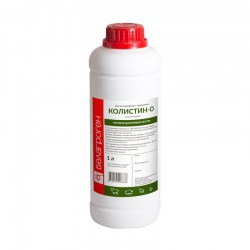 Colistin-O
 Enmitryl 50