+375 17 317 14 14 (sales dept.)


Dimicarb
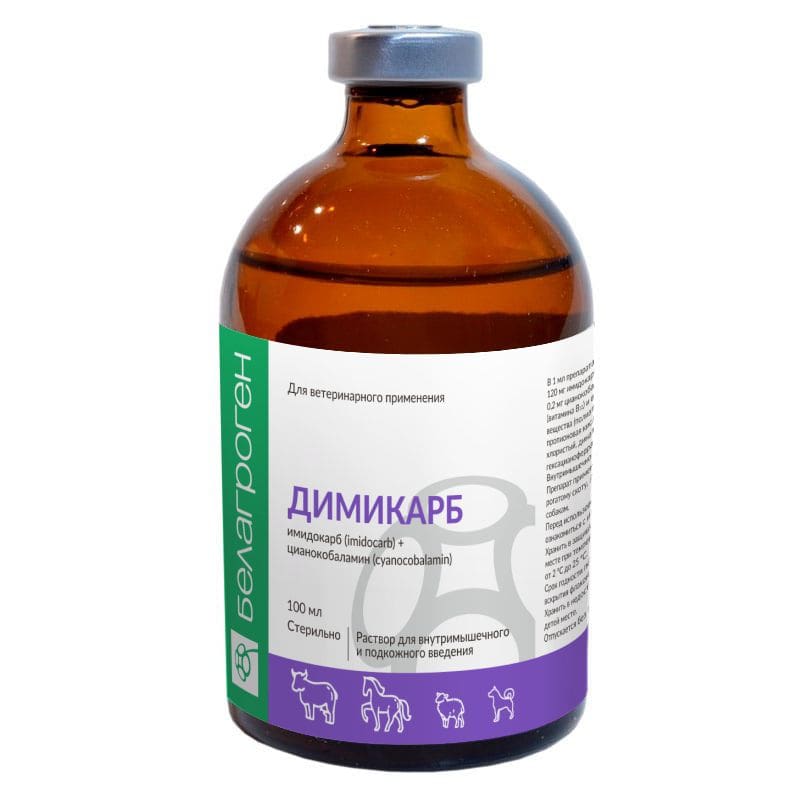
Veterinary drug DIMICARB
Prevention and treatment of parasitic diseases caused by blood parasites
- Antiprotozoal effect
- Supports hematopoiesis function
- Becomes active 18-24 hours after injection
- Long-lasting action (4-6 weeks)
- Short withdrawal period for milk intended for human consumption (4 days)
Therapeutic indications:
Veterinary drug DIMICARB is administered to cattle, sheep, horses, dogs for therapeutic and prophylactic purposes in blood-parasitic diseases - babesiosis (pyroplasmosis), nuttalliosis, anaplasmosis etc.
Composition of the veterinary drug:
1 ml DIMICARB solution contains:
- Imidocarb dipropionate 120 mg
- Cyanocobalamin (vitamin B12) 0.2 mg as active substances;
Pharmacological activity:
Active substances of the veterinary drug are imidocarb dipropionate and cyanocobalamin (vitamin B12).
Imidocarb has antiparasitic activity against Babesia bovis, Babesia ovis, Piroplasma bigeminum, Babesia divergens, Piroplasma canis, Piroplasma caballi, Babesia gibsoni, Francaiella colchica, Theileria annulata, Theileria equi, Theileria sergenti, Theileria mutans, Theileria orientalis, Theileria ovis, Theileria recondita, Theileria tarandirangiferis, Nuttallia equi, Anaplasma marginale, Anaplasma ovis, and also Ehrlichia canis.
Imidocarb suppresses the intake of inositol, which is vitaly necessary for blood parasite, as well as hampers the production and metabolism of polyamines by parasites. After parenteral administration of the veterinary drug, imidocarb reaches its therapeutic concentration in blood in 18-24 hours. This concentration is maintained at the same level for 4-6 weeks. Imidocarb accumulates mainly in kidneys and liver, and is excreted mainly with urine.
Cyanocobalamin is a growth factor that is necessary for normal hematopoiesis and maturation of red blood cells. Cyanocobalamin is involved in the synthesis of choline, methionine, creatine and nucleic acids.
Dosage:
The veterinary drug is administered in accordance with the rules of aseptic and antiseptic, in the neck, by subcutaneous or intramuscular injection, in the following doses:
|
Species |
Dose (ml/100 kg body weight) |
| Cattle | |
|
Prevention and treatment of babesiosis, piroplasmosis |
2 (single administration) |
|
Prevention and treatment of anaplasmosis and mixed invasions |
2.5 (single administration) |
|
Elimination of carrier state |
4 (double dose, at 14 days interval) |
|
Horses |
|
|
Prevention and treatment of babesiosis, piroplasmosis |
2 (single administration) |
|
Elimination of carrier state of Babesia caballi |
4 (double dose, at 24 hours interval) |
|
Elimination of carrier state of Babesia equi |
4 (4 times, at 72 hours interval) |
|
Sheep |
|
|
Treatment of babesiosis, anaplasmosis and mixed invasions |
0.2 (single administration) |
|
Dogs |
|
|
Prevention and treatment of piroplasmosis |
- for prevention 0.25 (single administration) - for treatment 0.5 (single administration) |
Due to the possible pain reaction during administration, the maximum volume of the drug should not exceed 10 ml for cattle in one injection site, 5 ml - for sheep, 2 ml - for dogs.
With preventive purposes, the drug is used when one or two animals in the herd have clinical signs of the blood-parasitic disease, when ixodic mites (carriers of blood-parasitic diseases) attack (or at the threat of such attack) on animals, as well as within a week after moving the animals to regions where these diseases are endemic: cattle - 1 time every 6 weeks, horses – 1 time in 4 weeks, for dogs – 1 time per season (the period of tick activity) when the possibility of ixodic ticks attack is high.
The protective effect in babesiosis is observed for 30-45 days, depending on the epizootic situation and the physiological state of the animal.
Dogs should be under the supervision of a veterinarian for at least 15 minutes after injection of the drug.
Before mass treatment, each batch of the drug should be tested on a small group of animals (3-5 heads). In the absence of complications, the entire livestock is treated within 3 days.
Precautions and adverse reactions:
In recommended doses, the veterinary drug doesn’t usually cause side effects and complications. In rare cases, a local reaction such as hyperemia or painful swelling at the injection site may occur; it disappears spontaneously within 1-2 days. In animals with increased individual sensitivity to the components of the drug, allergic reactions may occur. In this case, the the drug is cancelled, if necessary, antihistamines are administred, symptomatic treatment is carried out.
Upon the mass death of blood parasites and the destruction of red blood cells after the use of the veterinary drug in animals, intoxication may occur. In this case, intensive therapy is prescribed, including intravenous administration of electrolytes and hepatoprotectors solutions.
Animals with clinical signs of babesiosis are recommended to be treated with antihistamines before administration of the drug.
Do not use in animals which are known to be hypersensitive to substances of the veterinary drug or emaciated animals.
Do not use in animals within 4 weeks after vaccination with a live vaccine against babesiosis or anaplasmosis.
In case of the overdose and/or animal’s hypersensitivity to the veterinary drug certain complications (bradycardia, increased and disturbed breathing, profuse salivation, lacrimation, sweating, muscle tremors, frequent urination and defecation) may occur. The use of drug should be cancelled and symptomatic treatment are prescribed.
Do not use simultaneously with organochlorine, organophosphorus preparations and other cholinesterase inhibitors. Do not mix in one syringe with other medications.
After the first administration and cancellation no peculiarities have been revealed.
Avoid missing the next administration of the drug to animals, as this may lead to a decrease in therapeutic efficacy. If administration of the veterinary drug is missed, resume it in the same dosage according to the same treatment scheme. It is not recommended to use a higher doses to offset a missed one.
The possibility of using the drug to females of small domestic animals during pregnancy and lactation, as well as to puppies, is determined by a veterinarian evaluating benefits against possible risks of using the drug. It is not allowed to use milk for feeding offspring within 4 days after the last use of the drug.
Do not use the veterinary drug in sheep whose milk is used for human consumption.
Withdrawal period:
Cattle, horses and sheep must not be slaughtered for human consumption within 28 days after the last treatment. Meat of animals forcibly slaughtered earlier than the specified period may be used for feeding carnivores. Milk from lactating cows and mares may only be taken after 4 days from the last treatment for human consumption. Milk of animals, which is taken earlier than the specified period, may be used for feeding animals after boiling.
Storage conditions:
Store in a dark place at a temperature of 2 °C to 25 °C.
Shelf-life:
Shelf-life of the veterinary drug under appropriate storage conditions is 18 months from the date of manufacture. Shelf-life after first opening: 28 days.
 Vermectin zero
 Cyflubag